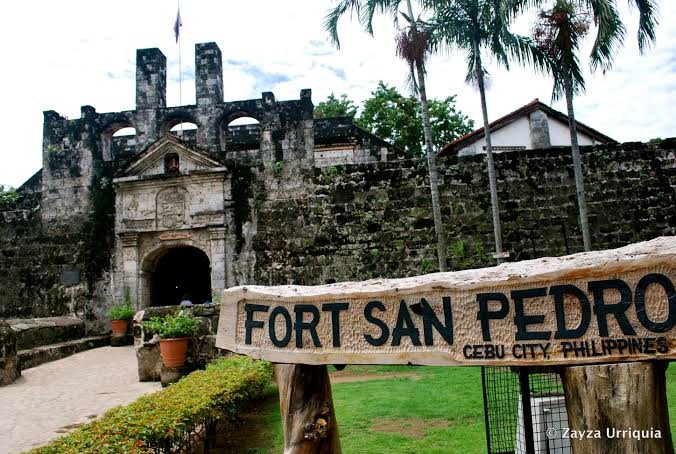
Fuerte de San Pedro is a military defense structure in Cebu, built by the Spanish under the command of Miguel López de Legazpi, first governor of the Captaincy General of the Philippines. It is located in the area now called Plaza Indepedencia, in the pier area of the city.
Fort San Pedro is said to be the oldest and the smallest fort in the Philippines, covering an area of 2,025 square meters. Its walls are 20 feet tall and 8 feet thick, forming a triangle with uneven lengths: two sides face the sea and the other the land, where the current entrance gate to the fort is located. The gate has two rectangular columns that flank a raised Philippine flag, that serves as the apex of the structure. Three tunnel-shaped windows sit on top of a gable which hosts a niche that shelters an image of the Sto. Nino, the city’s patron saint. Below it is another shallower niche marked with a seal, which I was told was the seal of the Spanish king. Below it is the entrance, a barrel vault, whose arch is topped with a spandrel that bears the Spanish name of the place and the year it was built.
Each corner of the triangular fort harbors a bastion — the Ignacio de Loyola in the southeast corner, La Concepcion in the southwest, and San Miguel in the north corner. On each corner stands a turret that serves as a watchtower. There are 14 cannons installed at the site along with a number of trees and ornamental plants that serve as inanimate ushers around the fort.
Today, Fort San Pedro is a fusion of a park which serves as an oasis in the middle of a bustling city and a museum where visitors can learn a great deal about the history of Cebu and the beginnings of the Spanish rule in the Philippines.

 Travel Marino